2026 Top Polyimide Tape Suppliers for Global Buyers
The 2026 Top polyimide tape Suppliers for Global Buyers guide examines a market shaped by heat, precision, and supply reliability. Polyimide tape supports circuit insulation, transformer manufacturing, battery assembly, aerospace wiring, and high-temperature masking. Its thin amber film may look simple. The performance requirements are not.
Grand View Research estimates that the global polyimide films market reached approximately USD 2.5 billion in 2023. Its report also projects steady growth through 2030, driven by electronics, electric vehicles, and advanced manufacturing. MarketsandMarkets identifies flexible electronics and semiconductor applications as major demand areas. These reports measure related film markets, not every tape category. Their figures should therefore be compared carefully.
Dr. K. L. Mittal, a recognized editor and researcher in high-temperature polymer technology, has emphasized, “Polyimide performance depends on the relationship between polymer structure, processing, and application conditions.” That principle matters when evaluating suppliers. Buyers should inspect film thickness, adhesive chemistry, dielectric strength, thermal range, release quality, and batch consistency. Certification records and test methods also deserve attention. A low quoted price can hide uneven coating or weak adhesion.
This supplier review considers manufacturers with documented production capabilities, export experience, technical support, and transparent quality systems. It also considers practical details, such as clean packaging, roll length accuracy, and response time after sampling. No ranking is perfect. Regional capacity, changing resin prices, and incomplete public data can affect the outcome. Buyers should verify every specification before placing volume orders. The strongest supplier is not always the largest. It is the one that performs consistently under the buyer’s actual process conditions.
Polyimide Tape Fundamentals: PI Film, Silicone Adhesive, and Key Grades
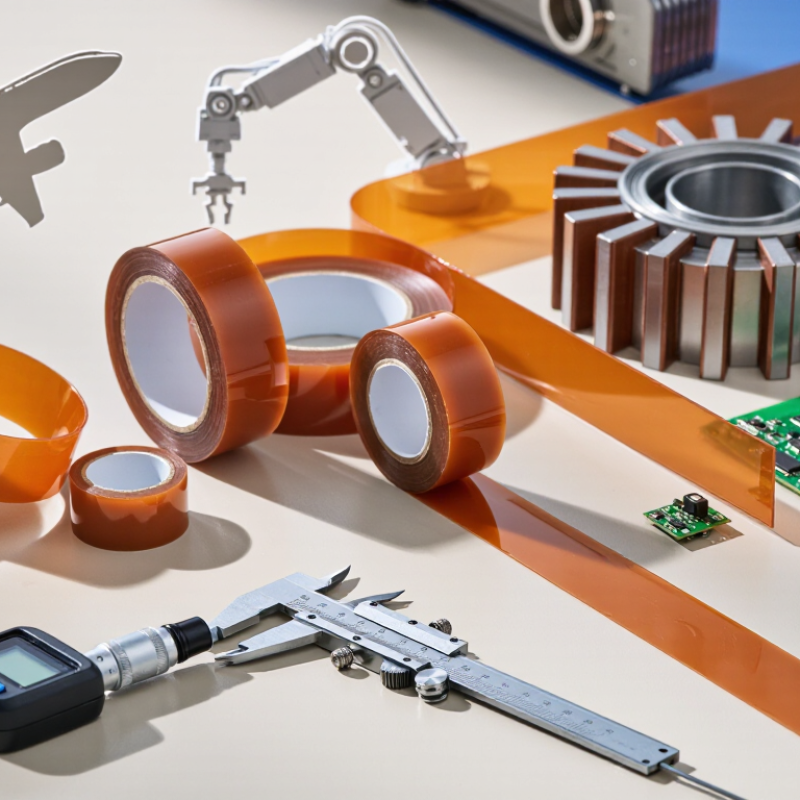
For global buyers in 2026, understanding polyimide tape starts with its three working parts: PI film, silicone adhesive, and grade selection. Polyimide film provides heat resistance, dimensional stability, and electrical insulation. This amber film stays reliable near soldering areas and winding operations. Its low moisture absorption also supports stable insulation performance. Film thickness matters. Thin tape follows tight curves. Thick tape offers stronger mechanical coverage.
Silicone adhesive controls how the tape performs in real assemblies. It should bond firmly to metal, plastic, glass, or coated surfaces. During thermal cycling, poor adhesive selection may cause edge lifting or residue. Watch for this. A suitable formulation balances tack, shear strength, temperature resistance, and clean removal. Suppliers should provide technical data, test conditions, and batch information. Ask for samples. Then test them on the actual substrate, not only stainless steel.
Key grades include standard electrical, high-temperature, antistatic, and conductive versions. Electrical grades suit coil insulation and circuit protection. High-temperature grades support repeated exposure to demanding process heat. Antistatic tape can reduce charge concerns during sensitive assembly work. Conductive versions serve specialized grounding or shielding designs, but their resistance must be verified. A practical qualification test uses production-length samples, several temperature cycles, and a controlled peel check. I have seen small laboratory tests hide edge-lift problems. That remains an easy mistake. Surface cleanliness, storage humidity, and operator pressure can change results more than expected.
Polyimide Tape Fundamentals: Typical Continuous-Use Temperature by Adhesive System
Polyimide (PI) film is valued for high-temperature resistance, dimensional stability, and electrical insulation. The adhesive system often determines the practical continuous-use temperature of the finished tape. The figures below are representative industry values; exact limits depend on formulation, tape construction, dwell time, and application conditions.
Silicone-adhesive polyimide tape is commonly selected for high-temperature masking, insulation, soldering, and powder-coating processes. Acrylic systems generally offer strong aging and chemical resistance at moderate temperatures, while rubber-based systems are typically used for lower-temperature applications.
Global Supplier Evaluation: ISO 9001, RoHS, REACH, Capacity, and Traceability
2026 Top Polyimide Tape Suppliers for Global Buyers
Selecting a polyimide tape supplier requires more than comparing price and adhesive color. Global buyers should examine ISO 9001 certification, audit records, and documented corrective actions. A certificate alone is not enough. Ask whether the quality system covers coating, slitting, packaging, and complaint handling. Experienced suppliers can explain how they control thickness, peel strength, dielectric performance, and temperature resistance during production.
Tips: Request current RoHS and REACH declarations, supported by test reports when available. Check revision dates. Confirm that restricted-substance data matches the exact tape grade and backing material. Also review monthly capacity, lead-time records, minimum order quantities, and emergency allocation procedures. A large stated capacity may not equal reliable availability.
Traceability should connect each shipment to raw materials, production dates, operators, inspection results, and packaging records. Lot codes should remain readable after storage and transport. During supplier evaluation, request a sample certificate of analysis and a mock recall exercise. This reveals how quickly the supplier can identify affected batches. I would not rely only on a polished factory presentation; production evidence is more persuasive. Some suppliers may lack perfect documentation, yet they should explain the gap and provide a realistic improvement plan. Reliability grows through verified records, consistent samples, and transparent communication.
Application-Based Selection: PCB Masking, Transformers, Motors, and EV Batteries
2026 Top Polyimide Tape Suppliers for Global Buyers
Application-Based Selection: PCB Masking, Transformers, Motors, and EV Batteries
Polyimide tape selection should follow the process, not the catalogue. For PCB masking, choose clean removal, stable dielectric strength, and controlled adhesive transfer. Thin tape improves edge definition during soldering. Transformers need stronger insulation systems, wider temperature tolerance, and reliable adhesion around sharp winding edges. IEC 60216 thermal ageing data can support this decision, but laboratory ratings do not always predict winding stress.
Motors create vibration, abrasion, and repeated heat cycles. Select tape with balanced tensile strength and flexibility around slots and lead wires. The International Energy Agency reports that motor systems consume more than half of global electricity. Reliability matters at this scale. EV battery assembly adds pressure. The IEA’s Global EV Outlook 2025 recorded more than 17 million electric car sales in 2024. Battery tapes need clean die-cutting, electrical insulation, and resistance to electrolyte exposure. A tape that works on a cell pouch may fail near busbars. That difference is often underestimated.
Tips: Request application samples, not only technical datasheets. Check adhesive residue after thermal cycling. Verify thickness across the roll. Ask for traceability, RoHS compliance, and test conditions. For PCB masking, inspect solder-line edges under magnification. For transformers and motors, test winding tension. Supplier claims need independent confirmation. Even experienced buyers can choose a strong tape with the wrong adhesive chemistry.
2026 Procurement Metrics: MOQ, Lead Time, Thickness Tolerance, and Total Cost
For global buyers, polyimide tape supplier selection should begin with measurable procurement data, not attractive catalog claims. Request the MOQ for each width, adhesive grade, and roll length. A low MOQ may raise unit pricing, while a high MOQ can tie up cash and create storage risk. Confirm whether quoted lead time covers sample approval, production, slitting, and export handling. In practice, sample orders may ship within seven days, but qualified production often needs three to six weeks.
Thickness tolerance deserves careful attention. Ask suppliers to state the nominal film thickness, adhesive thickness, total thickness, and allowable deviation in microns. Also request the test method and inspection records. A tape listed as 50 microns may perform differently if the adhesive layer varies across the roll. Check winding quality, edge condition, release liner stability, and temperature performance using production-like samples. Small defects become expensive during automated application.
Total cost includes more than the quoted roll price. Include tooling, custom cores, packaging, freight, duties, inspection, rejected rolls, and inventory financing. I once compared suppliers using unit price alone; the cheapest offer became less attractive after split shipments and excess waste. That mistake still matters. Build a landed-cost model with realistic yield assumptions and at least two order volumes. Keep acceptance criteria in writing, including thickness tolerance, roll length, core dimensions, and replacement procedures for nonconforming material. Supplier evidence should be recent, traceable, and tied to the exact production specification.
2026 Top Polyimide Tape Suppliers for Global Buyers - 2026 Procurement Metrics: MOQ, Lead Time, Thickness Tolerance, and Total Cost
Anonymized 2026 procurement benchmark for common polyimide tape supply categories
| Supplier Segment | Typical Tape Construction | Common Thickness | Thickness Tolerance | Typical MOQ | Standard Lead Time | Custom-Order Lead Time | Indicative Unit Price | Estimated Total Cost per 100 m² | Supply Reliability |
| High-volume export supplier | Polyimide film with silicone pressure-sensitive adhesive | 0.055 mm | ±0.005 mm | 500 rolls | 15–22 days | 25–35 days | US$0.42–0.68 / roll | US$145–225 | ★★★★☆ |
| High-volume export supplier | Polyimide film with silicone adhesive for powder coating and masking | 0.075 mm | ±0.006 mm | 300 rolls | 18–25 days | 28–40 days | US$0.58–0.95 / roll | US$185–295 | ★★★★☆ |
| Industrial-grade converter | Polyimide film with high-temperature silicone adhesive | 0.100 mm | ±0.008 mm | 200 rolls | 20–28 days | 30–45 days | US$0.82–1.35 / roll | US$250–390 | ★★★★☆ |
| Precision electronics supplier | Thin polyimide film with low-residue silicone adhesive | 0.050 mm | ±0.004 mm | 100 rolls | 22–30 days | 35–50 days | US$0.95–1.65 / roll | US$310–510 | ★★★★★ |
| Industrial-grade converter | Polyimide film with acrylic adhesive for long-term bonding | 0.080 mm | ±0.007 mm | 200 rolls | 20–30 days | 30–45 days | US$0.72–1.20 / roll | US$230–355 | ★★★★☆ |
| Specialty ESD supplier | Static-dissipative polyimide tape with silicone adhesive | 0.070 mm | ±0.006 mm | 100 rolls | 25–35 days | 40–55 days | US$1.35–2.20 / roll | US$425–680 | ★★★★☆ |
| Precision electronics supplier | Polyimide tape with ultra-clean silicone adhesive for PCB processing | 0.060 mm | ±0.005 mm | 100 rolls | 25–35 days | 40–60 days | US$1.20–2.05 / roll | US$390–635 | ★★★★★ |
| Low-MOQ regional supplier | General-purpose polyimide film with silicone adhesive | 0.050 mm | ±0.008 mm | 25–50 rolls | 7–14 days | 20–30 days | US$1.80–3.20 / roll | US$560–980 | ★★★☆☆ |
Procurement basis: Prices are indicative 2026 market benchmarks in USD for standard 25 mm × 33 m rolls. Estimated total cost per 100 m² includes tape value, standard export packaging, routine quality inspection, and typical international freight allocation; duties, taxes, expedited freight, and tooling are excluded. Actual results vary by width, roll length, adhesive formulation, order volume, destination, Incoterms, and qualification requirements.