
Understanding what a Glass Magnesium Rock Wool Sandwich Panel is begins with its layered construction. This building panel usually combines glass magnesium boards with a rock wool insulation core. The outer boards provide a firm, smooth surface. The rock wool core improves thermal resistance and sound absorption. That layered design matters.
In practical projects, these panels may serve as interior partitions, exterior walls, ceilings, and cleanroom enclosures. They often arrive as factory-made units with straight edges and consistent dimensions. This can reduce installation time and limit wet construction work. However, panel performance depends on more than its materials. Joint treatment, fastener spacing, moisture control, and supporting frames all influence the final result. Small gaps cause large problems.
From an engineering perspective, rock wool is generally recognized for its non-combustible mineral composition. Still, the complete panel assembly requires tested fire-performance data. The glass magnesium surface may resist moisture better than some conventional boards, but it is not automatically waterproof. Reliable manufacturers should provide product specifications, test reports, dimensional tolerances, and installation guidance. Independent verification is valuable for fire rating, thermal performance, and sound control.
Field experience commonly shows that careful handling prevents chipped corners and damaged edges. Installers should inspect every panel before fixing it. Designers should also consider local climate, wall loads, ventilation, and maintenance access. This product is not a universal answer. Some descriptions oversimplify its benefits. A responsible evaluation compares the panel with alternative systems, project standards, and actual site conditions.
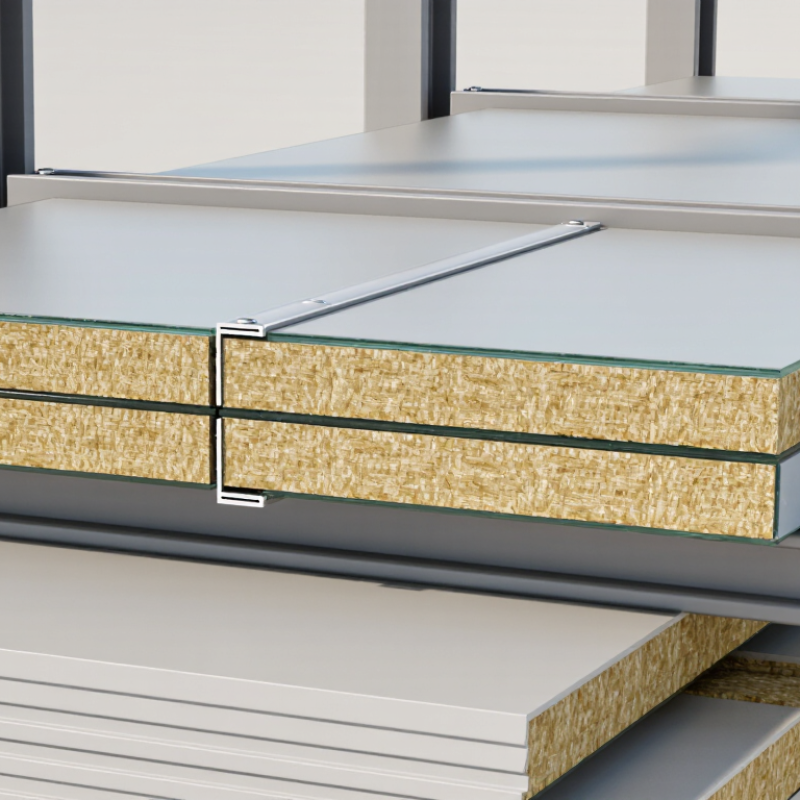
A glass magnesium rock wool sandwich panel is a prefabricated building panel with layered construction. Its outer skins are glass magnesium boards, while rock wool forms the insulated core. The boards usually contain magnesium oxide, magnesium salts, mineral fillers, and reinforcing fibers or mesh. Rock wool is made by spinning molten mineral material into dense, resilient fibers.
This composition gives the panel a practical balance of strength, fire resistance, thermal insulation, and sound control. The glass magnesium skins provide a firm, smooth surface for interior or exterior finishing. The rock wool core slows heat transfer and can reduce airborne noise between rooms. Panel performance depends on core density, board thickness, joint design, and manufacturing quality. A thicker panel is not always better. Poor edge sealing can still create weak points.
Tips: Check the declared fire rating, thermal conductivity, density, and moisture resistance before installation. Keep panels dry during storage. Protect exposed edges from rain and impact. Use compatible fasteners and sealants, because unsuitable materials may cause corrosion or surface staining. On site, inspect every joint carefully. Small gaps matter. The panel may resist moisture, but it should not be treated as completely waterproof. Local climate, ventilation, and drainage still influence long-term performance. Experienced installers should follow tested assembly details rather than relying only on the core material’s advertised properties.
What Is Glass Magnesium Rock Wool Sandwich Panel?
Core Structure and Manufacturing Process
A glass magnesium rock wool sandwich panel combines rigid glass magnesium boards with a dense rock wool core. The outer boards provide surface hardness, impact resistance, and dimensional stability. Glass fibers inside the boards help improve reinforcement. The rock wool layer supplies thermal insulation and sound absorption. It also helps slow heat transfer during fire exposure, but its final performance depends on the complete panel system.
Manufacturing begins with careful inspection of the boards and rock wool. Workers cut both materials to matching dimensions. The rock wool fibers are usually arranged to support strength and insulation requirements. Adhesive is then applied evenly across the contact surfaces. Small gaps can reduce bonding quality. This step needs patience and accurate control. The layers are aligned and pressed together under controlled pressure. After curing, the panel edges are trimmed and checked for flatness, thickness, bonding, and surface defects.
Production conditions matter greatly. Excess moisture may affect the glass magnesium boards. Uneven adhesive coverage can create weak areas. In practice, no process is perfectly uniform. That is why reliable manufacturers use sampling, dimensional measurement, and bond-strength testing. Fire and insulation results should come from tested assemblies, not assumptions based only on raw materials. Proper storage is also necessary, because damaged edges or prolonged moisture exposure may affect installation quality.
What Is Glass Magnesium Rock Wool Sandwich Panel?
Glass magnesium rock wool sandwich panels combine a rigid glass magnesium facing with a mineral wool core. Their performance depends on thickness, density, joints, and installation quality. EN 13162 data commonly places rock wool thermal conductivity near 0.035–0.045 W/m·K. A 100 mm core can therefore provide strong insulation, although thermal bridges may reduce the calculated result.
Fire resistance is a major advantage. Suitable mineral wool products can achieve Euroclass A1 under EN 13501-1, meaning they are non-combustible under the classification test. However, the complete panel requires separate testing. Seams, fasteners, and penetrations can change the result. ASTM E136 evaluates material behavior at high temperature, but it does not replace a full assembly fire test. The weak point is often the joint.
Acoustic performance is more complicated. ISO 10140 laboratory testing measures airborne sound insulation, while real sites may perform worse because of gaps and rigid connections. Heavier facings and a thicker core usually improve sound reduction. Mechanical data under EN 14509 should include bending, tensile, shear, and compression values. Panels with dense cores can resist handling and wind loads, but unsupported spans still require engineering checks. A practical installation detail is simple: seal every perimeter joint and inspect damaged edges before closing the wall. Small defects matter. Industry reports often show excellent laboratory values, yet field performance remains less predictable.
| Performance Dimension | Typical Data / Range | Unit | Technical Meaning and Notes |
|---|---|---|---|
| Panel composition | Glass magnesium boards with a rock wool insulation core | — | The MgO-based facing boards provide a rigid, impact-resistant surface, while the mineral wool core contributes thermal, fire, and acoustic insulation. |
| Common overall thickness | 50–150 | mm | The required thickness depends on the target U-value, fire-rating specification, acoustic objective, span, and support spacing. |
| Rock wool core density | 80–150 | kg/m³ | Higher density can improve dimensional stability, resistance to airflow, and mechanical performance, but it also increases panel weight. |
| Thermal conductivity of rock wool core | 0.035–0.045 | W/(m·K) | Typical design values vary with density, temperature, moisture, and test method. Lower conductivity indicates better insulation. |
| Approximate thermal resistance of 100 mm core | 2.2–2.9 | m²·K/W | Calculated approximately as thickness divided by conductivity; board layers, joints, fasteners, and thermal bridges reduce the installed value. |
| Approximate U-value of 100 mm panel | 0.32–0.43 | W/(m²·K) | Indicative whole-panel range based on the core conductivity and typical surface resistances; project calculations should include joints and fixings. |
| Reaction to fire of mineral wool core | Usually Euroclass A1 | Classification | Stone wool is generally non-combustible when tested as a suitable product. The classification of the complete sandwich panel must be verified separately. |
| Glass magnesium board fire behavior | Non-combustible formulations are available | — | Fire performance depends on formulation, thickness, reinforcement, joints, adhesives, and surface finishes; product certification is required for compliance. |
| Fire-resistance rating | Project-specific; commonly 30–120 minutes for tested assemblies | min | Integrity, insulation, and load-bearing ratings apply only to the tested construction, including panel thickness, supports, fasteners, joints, and penetrations. |
| Sound absorption coefficient, NRC | Approximately 0.70–1.00 when the mineral wool is exposed or used behind a perforated lining | NRC | A closed MgO-faced panel does not automatically provide this absorption level. Surface perforation, cavity depth, and mounting arrangement are critical. |
| Sound transmission performance | Typically better than a single thin board; exact Rw/STC must be tested | dB | Mass, airtightness, panel joints, flanking paths, core thickness, and resonance control govern airborne sound insulation. No universal rating applies to every panel. |
| Core compressive strength | 40–120 | kPa | Typical range for rigid rock wool products at specified deformation; the declared value depends strongly on density and test standard. |
| Glass magnesium board thickness | 5–12 | mm per face | Thicker facings generally improve surface rigidity and impact resistance but increase mass and may affect cutting and installation. |
| Approximate panel mass | 15–30 | kg/m² | Indicative for common thicknesses and densities. Actual mass must be checked for structural handling, lifting, and support design. |
| Dimensional stability | Low thermal movement; joints still require allowance | — | Rock wool is dimensionally stable, but moisture, temperature changes, board movement, and building settlement can affect joints and finishes. |
| Moisture resistance | Good when edges and joints are correctly sealed | — | Rock wool is water-repellent in many building products, but prolonged water exposure can reduce thermal performance. MgO boards require compatibility and moisture-control detailing. |
| Typical applications | Interior partitions, exterior walls, roofs, cleanrooms, industrial buildings, and acoustic enclosures | — | Selection must be based on the required fire, thermal, acoustic, structural, moisture, hygiene, and installation performance of the complete assembly. |
Note: The figures above are representative engineering ranges for generic glass magnesium rock wool sandwich panels, not guaranteed product ratings. Final values should be confirmed by project-specific test reports, declared performance documents, and local building-code requirements.
What Is Glass Magnesium Rock Wool Sandwich Panel?
A glass magnesium rock wool sandwich panel combines glass magnesium boards with a dense rock wool core. The outer boards provide rigidity and surface protection. The rock wool layer supports thermal insulation, fire resistance, and sound reduction. This structure suits projects where safety and energy control matter. However, performance depends on panel thickness, joint design, fixing methods, and tested assembly details.
Common Applications in Buildings and Industrial Facilities
In commercial buildings, these panels are often used for exterior walls, internal partitions, ceilings, and service areas. They can help separate offices from noisy mechanical rooms. They also support temperature control in warehouses, workshops, and equipment enclosures. Industrial facilities may use them around production zones, storage spaces, utility rooms, and controlled environments. Their non-combustible mineral core is useful near heat-producing equipment, but it does not remove every fire risk. Openings, cable penetrations, and poorly sealed joints can weaken the whole system. That detail is easy to underestimate.
Tips: Check fire, acoustic, thermal, and moisture requirements before ordering. Confirm the panel’s tested rating, density, and installation limits. Keep cut edges protected from long-term water exposure. Use compatible fasteners and sealants. A site inspection is worthwhile. Panels are efficient, but not a universal solution. Condensation can still appear when vapor control is poorly planned. Experienced installers should review corners, doors, roofs, and service penetrations before work begins.
Glass magnesium rock wool sandwich panels are commonly used for exterior walls, roofs, cold-storage enclosures, cleanrooms, and internal partitions. The chart shows indicative rock wool core thickness ranges frequently considered for these applications. Final thickness selection depends on thermal targets, fire safety requirements, structural loading, humidity, and local building codes.
Glass magnesium rock wool sandwich panels combine a glass magnesium facing with a non-combustible mineral wool core. Their value depends on the complete assembly, not one material. UNEP’s 2024 Global Status Report states that buildings consume 32% of global energy and generate 34% of global carbon emissions. Better envelopes therefore deserve careful selection.
Select panels by fire rating, thermal performance, acoustic needs, wind loads, and humidity exposure. Rock wool commonly provides thermal conductivity around 0.035–0.045 W/m·K under EN 13162 testing conditions. Ask for test evidence under EN 14509 and EN 13501-1.
A board that looks strong may still fail at joints. That detail is often underestimated.
During installation, check substrate flatness before fixing panels. Keep edges dry, align joints tightly, and seal penetrations with compatible materials. Fasteners must suit the supporting structure and design loads. Avoid crushing the core. It happens easily.
Maintain the system through yearly inspections, especially after storms. Look for open seams, damaged coatings, corrosion, and trapped moisture. The U.S. Department of Energy identifies uncontrolled air leakage as a major source of building energy loss, so damaged seals should not be treated as cosmetic defects.
Cleaning should use mild water-based methods. Harsh chemicals may weaken surface protection.
Reflective note: installation speed is useful, but rushed detailing can erase the panel’s expected performance.
